

On July 4th, we’ll celebrate America’s 250th birthday, but I’ve long thought it’s the wrong date. The United States wasn’t born in 1776 because the states were hardly united at all. They more closely resembled thirteen nation-states with a collective interest in throwing out the British. A better day to choose for America’s birthday would be March 4th, 1789. It was on this day we became a contiguous nationstate, because it was on this day the Constitution went into effect.
If you’re like me, then your basic narrative of the birth of the Constitution goes something like this: The colonies win the Revolutionary War with a system of government called the Articles of Confederation. Within a few years it becomes clear that the Articles are no good. They convened a private convention, applied some nouveau political science principles from Europe, and delivered the Constitution that we have today.
While this story is fine, it leaves many questions unanswered. What specifically was so bad about the Articles? How did the founders go about making all of the design decisions of the Constitution? How did they sell it to the public? People invoke the intentions of the founders all the time, but what did they really think? I picked up The Federalist Papers to answer these questions.
The Constitutional Convention publicly submitted the proposed Constitution to the states for ratification in September 1787. Almost immediately, critiques began appearing under not-so-subtle pen names like “Cato” and “Brutus,” arguing against ratification because it came at the expense of certain liberties. These essays we now call the Anti-Federalist Papers.
Between October 1787 and April 1788, 85 essays were published in response under the anonymous pen name Publius. These essays we now call The Federalist Papers. While Publius’ identity was suspected at the time, it is not disputed now. Publius was not a single person, but three: John Jay, James Madison, and Alexander Hamilton.
The intention of the next 10,000 words is to distill the contents of The Federalist Papers with some modern interpretation, and an attempt at a quintessence of why they matter today.
Federalist 1 to 36: Why we need a Union
The first 36 essays don’t focus much on the new Constitution itself, rather, they lay the groundwork for why a new Constitution is needed in the first place, and why it should be a federal republic.
General Introduction (No. 1, Hamilton)
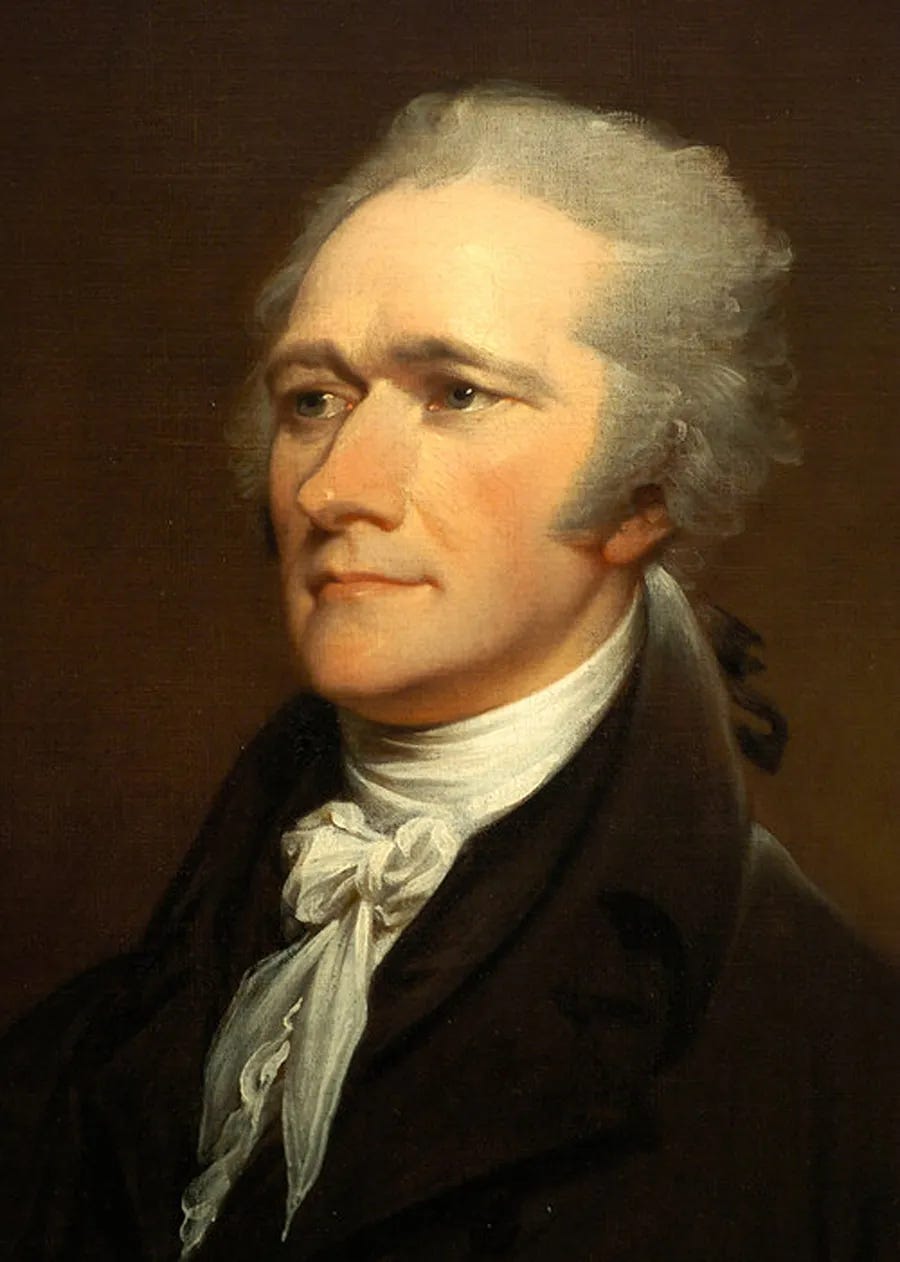
The subject speaks its own importance; comprehending in its consequences nothing less than the existence of the Union, the safety and welfare of the parts of which it is composed, the fate of an empire in many respects the most interesting in the world.
Hamilton is framing what this entire debate is about: the long-term welfare of the states. That is the goal. One side believes welfare is maximized if each state maintains full sovereignty, another thinks 3-4 smaller confederacies would be ideal, and Hamilton believes a single union of all the states would be the best for the welfare of its constituents.
Hamilton tries to reframe the debate, as the Anti-Federalists wanted, as being about liberty versus tyranny. He makes the point that tyranny does not arise exclusively from those espousing to expand the power of government (like he is), but instead shows that history is littered with cloaked despots championing the rights of the people. We must not forget the erudition of the founding fathers, particularly around the subject of political history. Pisistratus, Caesar, and Cromwell were evidence for Hamilton’s claim, just as Napoleon and the 20th century authoritarians would prove his clairvoyance. (Emphasis my own)
A dangerous ambition more often lurks behind the specious mask of zeal for the rights of the people than under the forbidden appearance of zeal for the firmness and efficiency of government. History will teach us that the former has been found a much more certain road to the introduction of despotism than the latter, and that of those men who have overturned the liberties of republics, the greatest number have begun their career by paying an obsequious court to the people; commencing demagogues, and ending tyrants.
Why a union makes us safe from foreign powers and ourselves (No. 2-8, Jay and Hamilton)
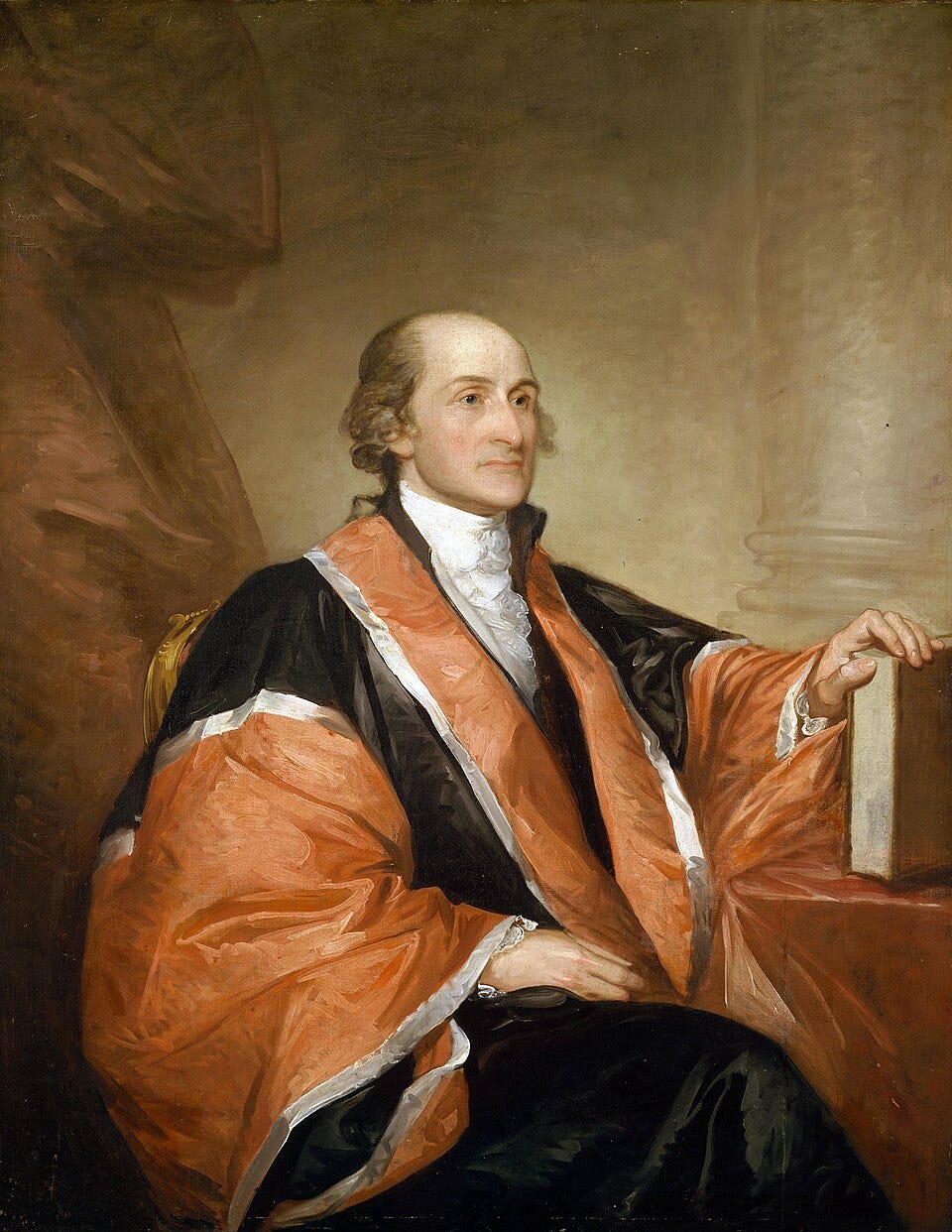
Jay begins No. 2 by furthering Hamilton’s framing of the debate as being on a spectrum. Some natural rights must be given up in order to maintain an effective government, but the benefits will outweigh the loss of those rights. Jay’s essays revolve around convincing us this is true from the aspect of defense.
Jay masterfully applies his understanding of Aristotelian rhetoric to persuade the audience of his case. He makes sure the reader knows that his arguments are recommendations rather than impositions, that the decision must be made by the people, who would be remiss to forget the magnitude and importance of their decision. This is an appeal to the reader’s ethos by implying that they are fair-minded and morally capable of making such a decision. It’s easy to see why Jay was the first Chief Justice of the Supreme Court.
A big benefit of a union is defense. He begins with the framing that wars begin due to causes, both just and unjust. The number of potential causes rises with the number of sovereign states. The more sovereigns, the more causes, which means more wars. A single sovereign on the other hand will leverage politics for dispute resolution both internally and externally, which is always preferable to war. A union also protects us from European interests:
Spain thinks it convenient to shut the Mississippi against us on the one side, and Britain excludes us from the Saint Lawrence on the other; nor will either of them permit the other waters which are between them and us to become the means of mutual intercourse and traffic.
Remember what the map looked like in 1789...
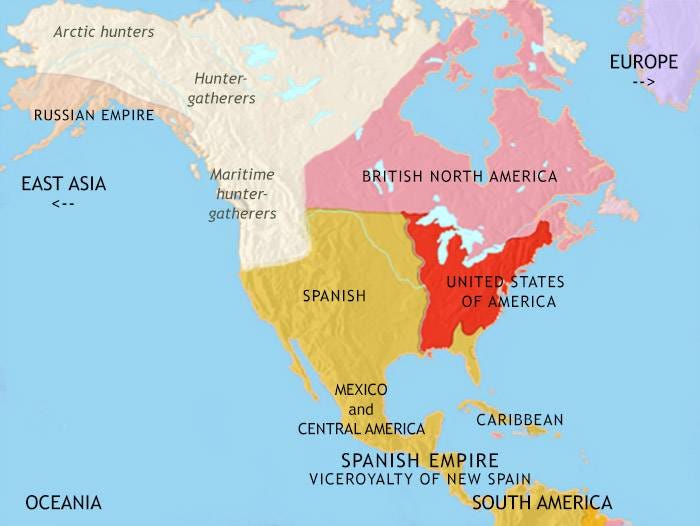
Jay’s argument is one that both appeals to the reader’s pathos while at the same time being 100% true. The American colonies were completely surrounded by powers that wished them ill.
A strong union doesn’t only mean a stronger vehicle to wage war, but it’s also a means of preventing it. He’s hitting on the historical truism that countries only attack you if they think they can win. Therefore, a strong unified military prevents war from happening in the first place. This is also the idea backing prolonged periods of peace during unipolar moments like the Pax-Romana and Pax-Americana.
He then moves towards counterexamples to prove his point:
What would the militia of Britain be if the English militia obeyed the government of England, if the Scotch militia obeyed the government of Scotland, and if the Welsh militia obeyed the government of Wales? Suppose an invasion; would those three governments (if they agreed at all) be able, with all their respective forces, to operate against the enemy so effectually as the single government of Great Britain would?
Look at how powerful Britain is! Could they have done all that if each of their states had separate militaries?
Jay then shifts towards hypothetical internal dynamics that would exist if the colonies instead became 3 to 4 sovereign confederacies. He again invokes the history of Great Britain:
The history of Great Britain is the one with which we are in general the best acquainted, and it gives us many useful lessons. We may profit by their experience without paying the price which it cost them. Although it seems obvious to common sense that the people of such an island should be but one nation, yet we find that they were for ages divided into three, and that those three were almost constantly embroiled in quarrels and wars with one another. Notwithstanding their true interest with respect to the continental nations was really the same, yet by the arts and policy and practices of those nations, their mutual jealousies were perpetually kept inflamed, and for a long series of years they were far more inconvenient and troublesome than they were useful and assisting to each other.
England, Scotland, and Wales were embroiled in wars for hundreds of years before realizing they were better off together. He wants the reader to learn from history rather than repeating it.
The Anti-Federalists made the case that republics are naturally peaceful towards each other, so a collection of individual republican confederacies would lead to peaceful coexistence. Much of No. 6 is Hamilton countering this claim by listing historical republics and their lack of peacefulness with their neighbors.
Sparta, Athens, Rome, and Carthage were all republics; two of them, Athens and Carthage, of the commercial kind. Yet were they as often engaged in wars, offensive and defensive, as the neighboring monarchies of the same times. Sparta was little better than a well-regulated camp; and Rome was never sated of carnage and conquest.
Hamilton’s breadth of historical knowledge is staggering, especially when one remembers the extent of information technology at the time was often-hard-to-come-by books.
After laying the historical precedent, he goes into potential reasons that the hypothetical American republics would go to war, the most compelling being disputes over territory. He foresaw westward expansion, and how competing interests without a centralized arbiter would resort to war. He lists examples of previous disputes between colonies that were mediated by the Crown or the Articles of Confederation.
If No. 6 argues that colonial republics would go to war, and No. 7 supports this claim through various reasons, No. 8 is about why this is bad. Obviously war is bad in the death and destruction sense, but Hamilton’s bigger fear was war as a justification for degrading civil liberties.
Safety from external danger is the most powerful director of national conduct. Even the ardent love of liberty will, after a time, give way to its dictates. The violent destruction of life and property incident to war, the continual effort and alarm attendant on a state of continual danger, will compel nations the most attached to liberty to resort for repose and security to institutions which have a tendency to destroy their civil and political rights. To be more safe, they at length become willing to run the risk of being less free.
His argument rests on the necessity of large standing armies, and the danger they pose to liberty. America’s geography gives it the privilege of not needing a large standing army to defend itself from powers across the sea. Only internal threats would necessitate the need for one. Hamilton uses Great Britain as an example of a country whose geography has allowed it to to forgo a large standing army, which has “contributed to preserve the liberty which that country to this day enjoys, in spite of the prevalent venality and corruption.” Britain avoided falling to the despotic demagoguery of the continent because its home island is very easy to defend with boats.
Hamilton’s warning in No. 8 has proved remarkably prescient. In the 250 years since he penned it, what he presented as a historical lesson has become historical fact. The Alien and Sedition Acts, the Habeas Corpus Suspension Act, the Japanese American internment, and the USA PATRIOT Act all illustrate the same pattern he described: war expands state power at the expense of liberty.
The feasibility of a large republic (No. 9-10 & 14, Hamilton & Madison)
The most referenced person throughout all 85 essays, by far, is the French political philosopher Montesquieu. The Anti-Federalists invoked Montesquieu (who was long dead at this point) to argue that a republic as large as the United States would be unsustainable. Because Montesquieu was enormously influential, having his authority on one’s side carried great weight. In No. 9, Hamilton responds by reclaiming Montesquieu for the Federalist cause.
Hamilton explains that the proposed Constitution would create a confederate republic in which multiple states unite under a federal system while retaining their internal governments. This structure, he claims, allows a large republic to exist without becoming tyrannical. To support this, Hamilton contrasts the Constitution with the unstable ancient republics of Greece and Rome, and highlights the modern political innovations, such as representation, checks and balances, and separation of powers, that make the new system possible.
Which gets us to perhaps the most famous essay in The Federalist Papers, and an introduction to the third and final author: James Madison’s No. 10.
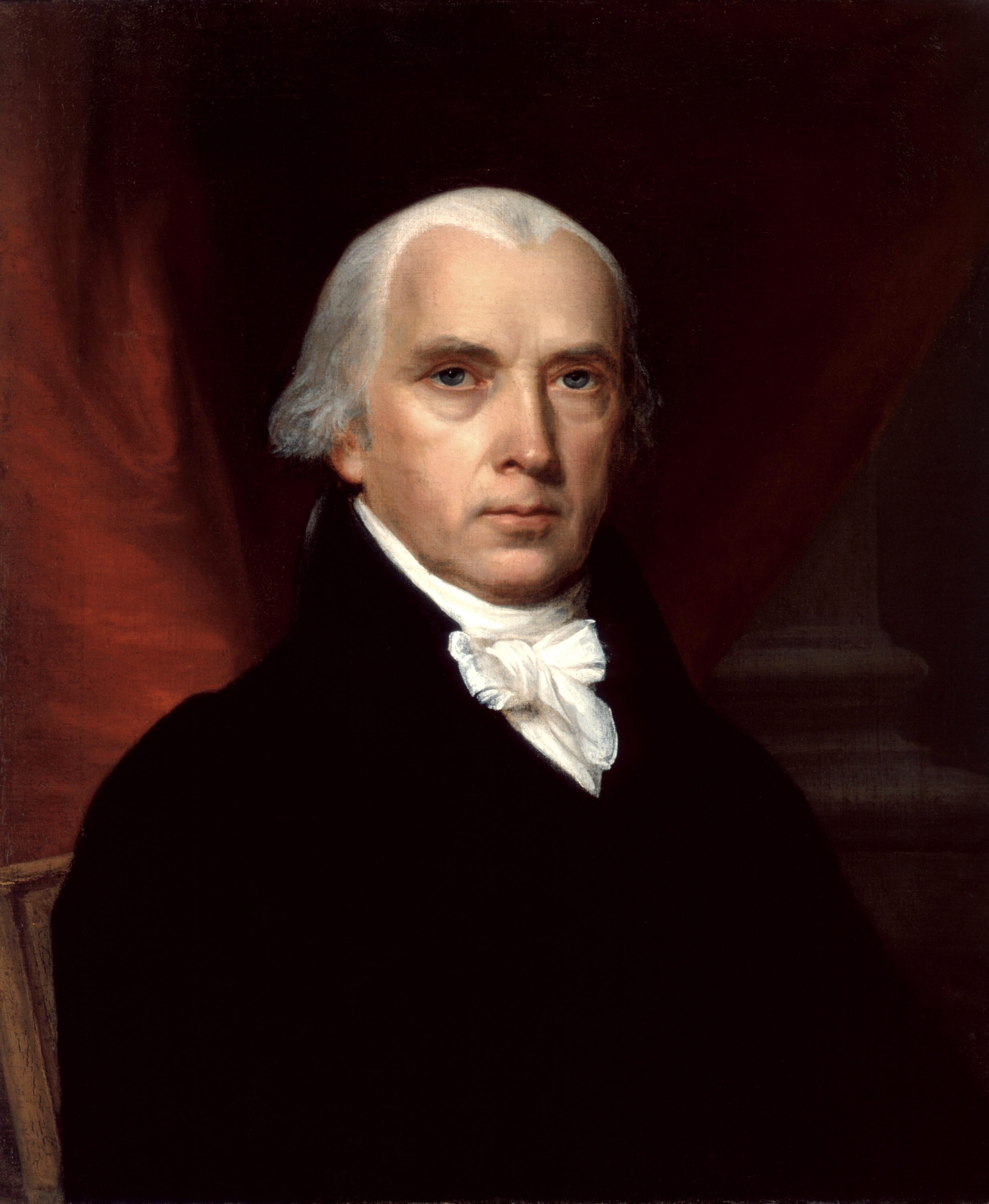
No. 10 explains the advantages of the Union in its “tendency to break and control the violence of faction.” Madison defines a faction as a group of citizens united by a common interest adverse to the rights of other citizens, or to the permanent and aggregate interests of itself. Note that factions are not the same as political parties. Factions are groups of people focused on a very specific issue: environmentalism or gun-rights, for example. But the most common and durable source of factions are those based on economic interests, such as apple farmers and bankers.
The founders were acutely aware of the existence of factions and how they expose a significant flaw in liberal democracies: a majority faction can trample minority factions.
Every shilling with which they overburden the inferior number, is a shilling saved to their own pockets.
Imagine 80% of Americans are apple farmers. Given they represent a majority, the apple farmers would pass legislation such as a price floor for apples that benefit the farmers at the expense of everyone else. This is obviously bad, but how do we prevent it? In a free society, factions cannot be eliminated without destroying liberty itself. The only option is to control their effects, of which Madison has two ideas.
First, you must have a representative democracy instead of a direct democracy. The representative acts as a filter from the desires of the various factions. A representative should be taking into account all the factions they represent, which in theory should prevent the domination by one. Second, Madison says that the larger the democracy, the less of an issue factions become. A large union brings economic and ideological diversity, which makes it harder for any one faction to gain a majority.
Madison then shifts back to why Montesquieu isn’t necessarily wrong to deride large democracies, he is just describing something different than what the Constitution proposes. Montesquieu said that large direct democracies were infeasible. Direct democracies involve every citizen getting, well, directly involved in votes and other required tasks. Madison’s proposed government is a republic, which relies on representative government, which actually gets more resilient with size.
It is, that in a democracy, the people meet and exercise the government in person; in a republic, they assemble and administer it by their representatives and agents. A democracy, consequently, will be confined to a small spot. A republic may be extended over a large region.
Why a union is more effective than disparate states (No. 11-13, Hamilton)
Hamilton proposes a few examples where the whole will be greater than the sum of its parts. First, is economics. A strong union will have more bargaining power for trade than many smaller states could ever have by themselves. This is undoubtedly true, and you see it everywhere throughout history: the Hanseatic League, OPEC, European Union, etc.
Second, Hamilton re-litigates Jay’s claims about improved defense capabilities. I won’t re-hash that argument.
Third, is economies of scale for taxation and administration. Given 18th century logistical and administrative challenges around tax collection, the preferred source of government revenue at that time was import duties (tariffs). In order to enforce tariffs, you must have your borders secured, else goods arriving from abroad get past the tax collector. Since all of America’s foreign imports come via ships and must arrive in port, a Union just needs to secure its ocean borders. Disparate republics, on the other hand, would have sea borders and land borders to worry about. And as we just learned, large groups of armed men securing land borders can also become a threat to liberty.
Why the Articles of Confederation suck (No. 15-22, Hamilton & Madison)
Are we in a condition to resent or to repel the aggression? We have neither troops, nor treasury, nor government. Are we even in a condition to remonstrate with dignity? ... Are we entitled by nature and compact to a free participation in the navigation of the Mississippi? Spain excludes us from it. Is public credit an indispensable resource in time of public danger? We seem to have abandoned its cause as desperate and irretrievable. Is commerce of importance to national wealth? Ours is at the lowest point of declension. Is respectability in the eyes of foreign powers a safeguard against foreign encroachments? The imbecility of our government even forbids them to treat with us. Our ambassadors abroad are the mere pageants of mimic sovereignty.
According to Hamilton, the structural defect of the Articles is “imperium in imperio,” or sovereignty layered atop sovereignty. The states retain their sovereignty, with broad control over their citizens, and the Articles sit on top of the states rather than reaching the people directly; it can only issue demands to the states who are free to comply or not. This is a fundamentally bad structure that guarantees either impotence or war. The remedy the Constitution proposed is to let both governments act directly on citizens rather than stacking one atop the other: both the federal and state government operate directly on the citizens in some ways.
Hamilton then dedicates three essays of historical case studies to prove the aforementioned point. The Amphictyonic Council, Achaean League, Holy Roman Empire, Swiss Confederacy, and the United Netherlands, are all examples that show how governments exclusively governing other governments is not an ideal setup for civil welfare.
This is all well and good, but what was actually wrong with the Articles? For starters, enforcement was a challenge:
The United States, as now composed, have no powers to exact obedience, or punish disobedience to their resolutions, either by pecuniary mulcts, by a suspension or divestiture of privileges, or by any other constitutional mode.
It also was unable protect the states from internal rebellion:
Without a guaranty the assistance to be derived from the Union in repelling those domestic dangers which may sometimes threaten the existence of the state constitutions, must be renounced.
Another was the fact that taxes were effectively optional:
The consequence clearly is that there can be no common measure of national wealth, and, of course, no general or stationary rule by which the ability of a state to pay taxes can be determined.
He also lists the inability to regulate commerce or raise an army, the lack of a unified judiciary, and the current system of state suffrage and unanimous voting, where every vote amongst the states had to be unanimous to pass. You can probably see why this was a problem. On that last point, he shows how unanimous voting can allow a foreign adversary to hold the government hostage by only needing to coerce a single state.
You need tools to do a job (No. 23, Hamilton)
No. 23 tees up Hamilton’s next twelve essays. He begins by listing out the purpose of a federal government: “the common defense of the members; the preservation of the public peace as well against internal convulsions as external attacks; the regulation of commerce with other nations and between the States; the superintendence of our intercourse, political and commercial, with foreign countries.”
If these are appropriate ends for a federal government, then we must also have the means to enact them. This is a direct challenge the Anti-Federalists - if you don’t want specific means, then you need to give up the ends.
...the means ought to be proportioned to the end; the persons, from whose agency the attainment of any end is expected, ought to possess the means by which it is to be attained.
The following twelve essays generally align with this idea.
Let’s talk about standing armies (No. 24-29, Hamilton)
It’s important to emphasize the concern over “standing armies” throughout the 18th and 19th centuries. A standing army is a permanent, professional military force maintained during peacetime. They were seen as vehicles of authoritarianism, and the best way to not have a tyrant use his army against you is to make sure there isn’t an army to begin with. The Anti-Federalists wanted Constitutional provisions against a standing army, with the assumption that state militias were sufficient to protect the country from internal and external threats.
Hamilton disagrees. If the ends of the federal government are to provide common defense and domestic tranquility, then militias are insufficient means to do so. Hamilton’s gripe with militias is that they are worse on both ends - the citizens don’t like them because they get yanked from their farms in irregular intervals and the government loses by getting a constant rotation of inexperienced farmers instead of professionals.
Hamilton’s case rests on the gap between the pace of a militia and the speed required to respond to threats. Remember that militias are called upon when they are needed, and dissolved after. A republic ringed by British, Spanish, and Native tribes does not choose when its tested; garrisons must be manned continuously, and a force that assembles only after danger appears arrives too late to deter it. Deterrence is the point - the army that prevents a war is worth more than the militia that eventually wins one. Hamilton turns the militia ideal against itself: insisting on citizen-soldiers as the only defense is not a safeguard of liberty but an invitation to defeat. And a defeated republic forfeits its liberty entirely, which is why a standing army is necessary.
But just because they’re necessary doesn’t mean they aren’t dangerous; it’s how you set them up that prevents their misuse. The Constitution handles this by giving the power to re-instate the standing army to the legislature, rather than the executive. The dangers of standing armies exist when they are under the sole discretion of a king or tyrant. Under Article 1, Section 8, of the Constitution, the legislature re-authorizes funding for the army every two years: “To raise and support Armies, but no Appropriation of Money to that Use shall be for a longer Term than two Years.”
He uses various historical examples of why this difference matters, including the 1689 English Bill of Rights which took the regulation of peacetime armies away from the king and gave it to parliament.
But even if the executive ignores the legislative decrees to dissolve the army, there are other reasons why authoritarianism would be difficult in America. The first is size. As was just shown with the British (and subsequent invasions of Russia by everyone), the sheer amount of American territory makes it challenging to hold the US coercively.
Second, the state militias themselves will act as a check.
It may safely be received as an axiom in our political system, that the State governments will, in all possible contingencies, afford complete security against invasions of the public liberty by the national authority.
A state’s ability to raise its own militia, when combined together, would be enough to repel the federal government’s standing army. This is the basis for a “well regulated militia” in the Bill of Rights.
Overall, I think Hamilton comes off looking pretty good here. American security and prosperity depends on a strong national military, but that force shouldn’t be a threat to the liberties of the people. So far, that’s been true. I don’t know if it was the 2nd amendment, the legislature controlling the purse-strings, size, or something else, but the 18th century concerns of standing armies have been generally unfounded in America over the last 240 years.
The federal government needs a flexible tax arrangement (No. 30-36, Hamilton)
There is one mean that is necessary for almost every end: taxes. Hamilton begins by rehashing one of the key failure points for the Articles of Confederation: inability to raise funds. The Articles essentially had to ask states for money, with no obligations for them to consent. Even the Anti-Federalists conceded this was a problem, so instead they proposed that the federal government could tax externally (tariffs), but internal taxation of the people should be left to the states. Again, Hamilton says this is no good. A federal government needs reliable tax revenue to fund itself and to get loans from foreign countries, the inability to tax directly would prevent both of these ends. War and future funding needs are unpredictable. If your only income stream is tariffs, what if other countries put up an embargo? Federal revenue would dry up instantly. In order for the government to last, it must have the ability to consistently raise the funds it deems necessary for its needs.
The Anti-Federalists have an argument that the federal direct taxation will crowd out the states ability to do so. Hamilton basically says this is nonsense, there isn’t a law of nature that says people can only be taxed by a single sovereign.
Federalist 37 to 85: Defending the Proposed Constitution
While there is no formal segregation between No. 36 and 37, there is a thematic shift towards defending the provisions of the Constitution itself, rather than high minded principles of federalism.
Compromise is hard (No. 37-40, Madison)
No. 37 to 40 give you a real sense of Madison’s personality. He was short, frail, and not known for being an impressive speaker. He was less fiery and weaker with the pen than Hamilton, but made up for it through his knowledge of government. Using our modern understanding of his education and his library, he was arguably the most knowledgeable person in the world on the principles of government.
One of my favorite essays in all of The Federalist Papers is No. 37, which Madison uses to set the stage for the remainder of the series: the Constitution is not perfect, but no one said it was. He disarms his opponents by admitting outright the impossibility of a perfect government. He outlines specific problems they faced when trying to draft the Constitution: federal versus state authority, powers of the branches of government, and reconciling the “requisite stability and energy in government, with the inviolable attention due to liberty and to the republican form.”
On that last point, Madison describes the trade off between liberty and government efficiency, which plays out in short versus long term lengths:
The genius of republican liberty seems to demand on one side, not only that all power should be derived from the people, but that those entrusted with it should be kept in independence on the people, by a short duration of their appointments; and that even during this short period the trust should be placed not in a few, but a number of hands. Stability, on the contrary, requires that the hands in which power is lodged should continue for a length of time the same. A frequent change of men will result from a frequent return of elections; and a frequent change of measures from a frequent change of men: whilst energy in government requires not only a certain duration of power, but the execution of it by a single hand.
Lastly, he has a great paragraph that feels like it belongs on Less Wrong, where he describes the challenge of using words to convey meaning.
The use of words is to express ideas. Perspicuity, therefore, requires not only that the ideas should be distinctly formed, but that they should be expressed by words distinctly and exclusively appropriate to them. But no language is so copious as to supply words and phrases for every complex idea, or so correct as not to include many equivocally denoting different ideas. Hence it must happen that however accurately objects may be discriminated in themselves, and however accurately the discrimination may be considered, the definition of them may be rendered inaccurate by the inaccuracy of the terms in which it is delivered. And this unavoidable inaccuracy must be greater or less, according to the complexity and novelty of the objects defined. When the Almighty himself condescends to address mankind in their own language, his meaning, luminous as it must be, is rendered dim and doubtful by the cloudy medium through which it is communicated.
Madison also feels the need to defend the existence of the constitutional convention itself. The mandate of the convention was to “fix the Articles”, not to come up with a totally new government. Madison argues that delivering a new government was still “in the spirit” of what the convention set out to do.
Laying out the powers of the federal government (No. 41-46, Madison)
Madison tries to answer the question of whether the federal government has been given any “unnecessary” or “improper” powers. He lists out six categories of power that are laid out in the constitution:
Security against foreign danger
Regulation of the intercourse with foreign nations
Maintenance of harmony and proper intercourse among the states
Certain miscellaneous objects of general utility
Restraint of the states from certain injurious acts
Provisions for giving due efficacy to all these powers
No. 41 handles the first category: security against foreign danger. There isn’t much here that we didn’t cover in Hamilton’s No. 24 - 29, further noting how the Anti-Federalists have artificially stirred the populace into a frenzy over standing armies, and how the Constitution is set up to prevent its misuse.
Next, the government has the power to regulate trade with foreign nations and maintain harmony and intercourse among the states. Most of this is uninteresting, standard stuff, but there is one part I want to drill into.
Article 1, Section 9 of the Constitution limits Congress’s ability to prohibit slavery for 20 years (until 1808). This is an example of a concession that was made to the southern states. Madison addresses this provision directly, framing it as a win. He argues that the southern states would never have signed on without it, and compared to the Articles (which had no ability to prohibit the slave trade), it’s a big improvement. While this can be viewed as kicking the can down the road, Madison would like it to be seen as a countdown clock that previously hadn’t existed.
It were doubtless to be wished, that the power of prohibiting the importation of slaves had not been postponed until the year 1808, or rather that it had been suffered to have immediate operation. But it is not difficult to account, either for this restriction on the general government, or for the manner in which the whole clause is expressed. It ought to be considered as a great point gained in favor of humanity, that a period of twenty years may terminate forever, within these states, a traffic which has so long and so loudly upbraided the barbarism of modern policy; that within that period, it will receive a considerable discouragement from the federal government, and may be totally abolished, by a concurrence of the few states which continue the unnatural traffic, in the prohibitory example which has been given by so great a majority of the Union. Happy would it be for the unfortunate Africans, if an equal prospect lay before them of being redeemed from the oppressions of their European brethren!
Madison has a long, complicated history with slavery. His writings show he disagreed with it on philosophical grounds, but he nevertheless owned hundreds of slaves throughout his life.
No. 43 describes the federal government’s “miscellaneous powers of general utility.” One example is patents: “to promote the progress of science and useful arts, by securing, for a limited time, to authors and inventors, the exclusive right to their respective writings and discoveries.” It doesn’t make sense for each state to enforce their own set of patents.
The next power Madison defends is “restraint of the states from certain injurious acts.” This includes things like making treaties, coining money, granting titles of nobility, etc. But the most interesting is not allowing non-democratic governments. Article 4, Section 4 of the Constitution states that the federal government is allowed to ensure the states are grounded in republican principles. A federalized republic doesn’t work if the underlying states have illiberal, undemocratic forms of government. Madison shows off his knowledge of political history and Montesquieu to make the point:
Governments of dissimilar principles and forms have been found less adapted to a federal coalition of any sort, than those of a kindred nature. “As the confederate republic of Germany,” says Montesquieu, “consists of free cities and petty states, subject to different princes, experience shows us that it is more imperfect than that of Holland and Switzerland.” “Greece was undone,” he adds, “as soon as the king of Macedon obtained a seat among the Amphictyons.” In the latter case, no doubt, the disproportionate force, as well as the monarchical form, of the new confederate, had its share of influence on the events.
Lastly, Madison discusses the sixth power: “provisions for giving due efficacy to all these powers” by defending the Necessary and Proper Clause. This is a controversial provision in Article I, Section 8 that grants Congress the power to create any laws required to execute the rest of its powers.
This leads to an interesting question: How do you define what a government can and can’t do? Madison outlines four possible routes:
Copy the Articles of Confederation and don’t give the power of the Federal government the authority for incidental powers.
List every single power the government can do and laws they can pass, down to the most minute detail, and don’t allow it to do anything else. This is impossible to do in practice and only gets worse as time goes on.
List every single power the government can’t do, down to the most minute detail. Same issue as #2.
Don’t list anything, with the implication that the government can do anything as long as it’s “necessary and proper” for carrying out the primary powers.
Madison implies that the fourth option is the only viable path. #1 just failed, #2 and 3 are infeasible, leaving #4 as the only remaining option.
Separation of powers (No. 47-51, Madison)
The concept of separation of powers had existed in governments prior to the American Constitution. The Roman Republic had it to some degree, along with the 1653 British Constitution. But the late 17th century saw a formalization of the idea thanks to Locke and Montesquieu.
No. 47 is entirely dedicated to the degree of separation of powers, and whether the Constitution has separated them enough. This is another essay where both sides are arguing whether or not they have Montesquieu on their side. Madison, of course, says that the US Constitution is aligned with what Montesquieu argued in The Spirit of the Laws.
From these facts, by which Montesquieu was guided, it may clearly be inferred that, in saying “There can be no liberty where the legislative and executive powers are united in the same person, or body of magistrates,” or, “if the power of judging be not separated from the legislative and executive powers,” he did not mean that these departments ought to have no partial agency in, or no control over, the acts of each other. His meaning, as his own words import, and still more conclusively as illustrated by the example in his eye, can amount to no more than this, that where the whole power of one department is exercised by the same hands which possess the whole power of another department, the fundamental principles of a free constitution are subverted.
One thing that becomes clear in this series of essays is that, in a democratic republic, the founders saw the legislature as the branch that should be most feared. The first reason is moral authority - the legislature should act as the most legitimate voice of the people, giving it a mandate the other two branches lack. Second, it controls the power of the purse, which gives it leverage that the other branches lack. Madison cites various examples of state constitutions, like Virginia and Pennsylvania, that were suffering from a tyranny of the legislature.
It is hard to be sympathetic with some of Madison’s claims while reading this in 2026. Our impotent legislature doesn’t seem to have any “moral authority” whatsoever with an approval rating of 14%. The fear I have of the legislature is its inability to do anything at all.
Anyway, Madison uses No. 49 and 50 to look at some of Jefferson’s ideas to resolve power disputes between the branches of government. Jefferson thought that since the people were the ultimate authority, then any time the branches stepped on each other’s toes, a convention should be convened to resolve it.
Madison thinks this is a horrible idea. Doing this would be a failure of government, stripping the stability and respect for the system as a whole. A constitution that constantly has to be re-opened has a harder time getting respect from the governed.
Instead, Madison argues in the famous No. 51, that the internal system itself must have the provisions to keep the powers in check. The American founders may not have come up with the separation of powers, but they largely invented formalized checks and balances. What results is likely the most famous quote in all The Federalist Papers:
Ambition must be made to counteract ambition. The interest of the man must be connected with the constitutional rights of the place. It may be a reflection on human nature, that such devices should be necessary to control the abuses of government. But what is government itself, but the greatest of all reflections on human nature? If men were angels, no government would be necessary. If angels were to govern men, neither external nor internal controls on government would be necessary. In framing a government which is to be administered by men over men, the great difficulty lies in this: you must first enable the government to control the governed; and in the next place oblige it to control itself. A dependence on the people is, no doubt, the primary control on the government; but experience has taught mankind the necessity of auxiliary precautions.
The House of Representatives (No. 52-61, Madison & Hamilton)
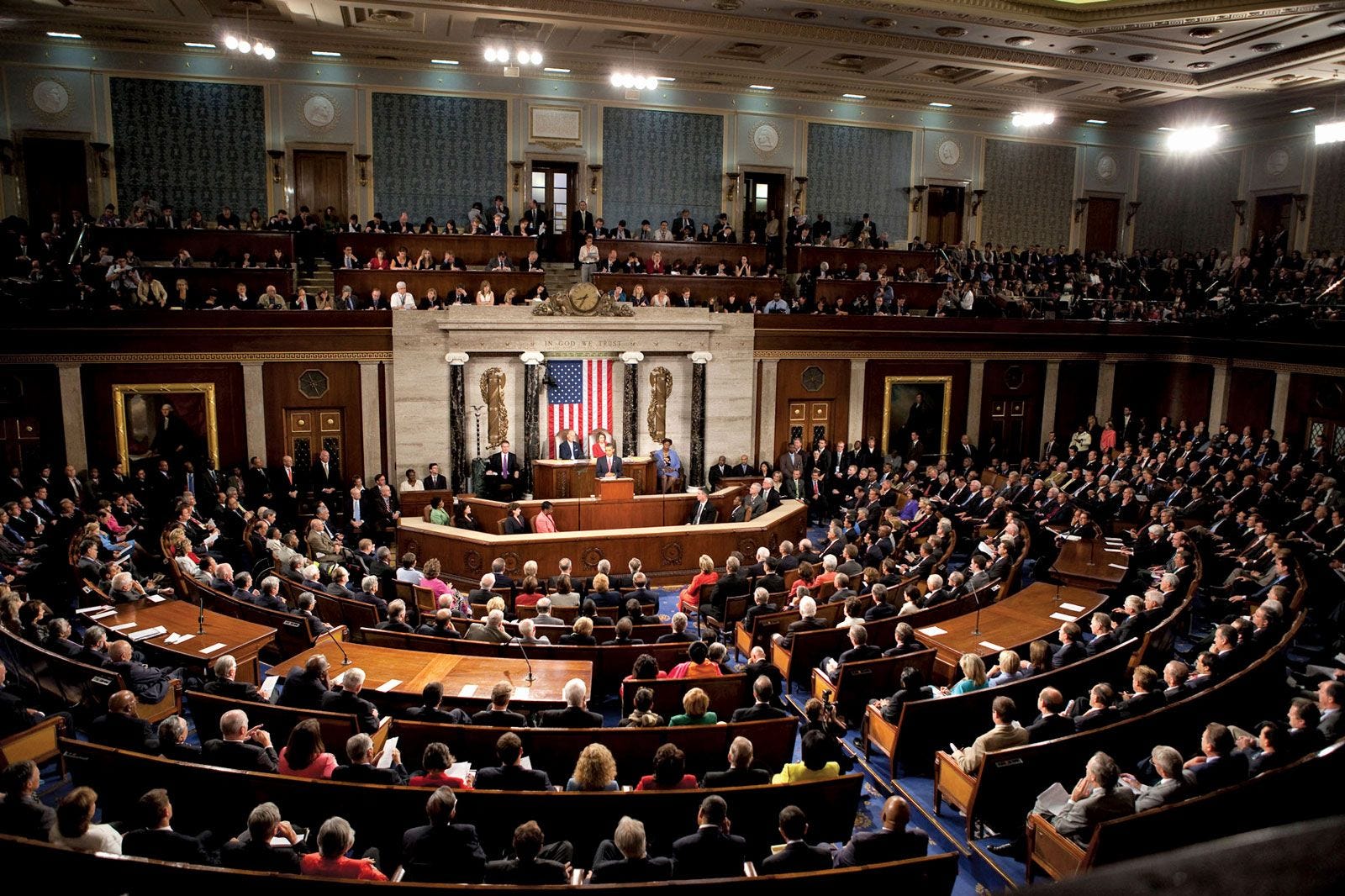
Madison and Hamilton use this series of essays to address decisions made in Article 1, Section 2 & 4 of the Constitution, which establishes the House of Representatives. There are five decisions that warrant explanation.
Who can be a representative?
The Constitution lists three formal qualifications to become a House representative: be 25 years old, a citizen for seven years, and when elected, be an inhabitant of the state you’re representing. Remember that originally the House was the only part of the federal government that the people elected directly, so Madison didn’t want to limit people’s preferences through eligibility.
Under these reasonable limitations, the door of this part of the federal government is open to merit of every description, whether native or adoptive, whether young or old, and without regard to poverty or wealth, or to any particular profession of religious faith.
What should term durations be?
Term durations represent a tradeoff between two variables: connection to the people and governing competence. The longer the term duration, the more likely the representative will drift away from the will of the people. But longer duration also leads to political skill and knowledge. An extreme situation with monthly elections would lead to useless politicians who perfectly reflected the will of the people; just as a situation with lifetime durations would lead to competent representatives who can do whatever they want.
With that in mind, what’s the right term length? For representatives, since they reflect the will of the people most acutely, we want to err on the side of connection to their constituents. The duration to maximize this while maintaining a minimum semblance of competence is apparently 2 years. Enough time to get good at your job while still being held accountable by the people.
How do you determine the ratio of representatives for each state? By land wealth? population?
This question is answered by No. 54, which is the most controversial essay in the entire series. There was some early thought to allocate representatives to states based on land value. This would act as both a proxy for population, but also more fairly apportion power to states that paid more in taxes. The challenge is that “land value” is hard to determine, especially in 1788. Therefore, they decided to go with population.
If population determined the number of representatives, the natural next question was whether slaves should count or not. The Northern states thought that the answer should be no. As long as the southern states continued to classify slaves as property without the ability to vote, they should not count in their representative apportionment. The Southern states obviously felt the opposite. What resulted is the infamous Three-fifths Compromise, which in Article 1, Section 2, said each slave added 0.6 to the population numbers of the southern states.
Madison does something in No. 54 that he doesn’t do in any of his other essays - he portrays the entire defense of the compromise through the persona of a hypothetical southerner. This allows him to present the rationalization while distancing himself from the ownership of it, probably because he found the position hard to defend directly.
Madison’s hypothetical southerner argues that slaves are not technically property, since they are protected (minimally) against violence from others, and are held responsible for their actions. But they are obviously not person’s either. Therefore, the Three-fifths Compromise treats their representation as the law treats them - partially a person, partially property.
The Three-fifths Compromise was morally wrong because slavery was morally wrong, but was itself necessary for ratification. I think a war was always going to be necessary to eliminate slavery. That war would either be between rival republics that failed to unify, or a civil war like the one we got.
How many total representatives should there be? 500? 5,000?
The Constitution does not specify the amount of representatives in the house. Rather, it sets a floor of 1 per state and a ceiling of 1 per 30,000 citizens. Madison avoided assigning a specific number because the ideal number depends on the size of the country. Remember the purpose of the house is to represent the will of the people, as opposed to the senate which represents the will of the states. A House with too few members for a large population will be less able to represent the interests of their constituents. However, a House with too many representatives will lead to an unruly mob.
In all very numerous assemblies, of whatever character composed, passion never fails to wrest the sceptre from reason. Had every Athenian citizen been a Socrates, every Athenian assembly would still have been a mob.
Prior to 1929, every ten years the House used the Census to adjust the ratio and the total number of the representatives. In 1929 the number became frozen at 435, and bumped to 437 with the addition of Hawaii and Alaska, where it remains today. This puts the ratio at roughly 780,000 people per representative, and rising.
Is this ratio too high? Probably yes. While a larger House would become more “unruly”, this could actually reduce the prevalence of partisan grid lock and reduce the power of faction. Interestingly, the original First Amendment to the Bill of Rights set the ratio firmly at 50,000, but it was never ratified. At our current population, this would result in about 6,630 members of the House. Since there was no time limit on ratification, it could still be passed today. (Not totally unfeasible - this exact thing happened in 1992 with the 27th Amendment, which got ratified after 203 years!)
Who controls the “time, place, and manner” for how representatives are elected?
Hamilton takes over to discuss the 5th question for the House of Representatives: who has power over elections. Article 1, Section 4. of the Constitution states:
The Times, Places and Manner of holding Elections for Senators and Representatives, shall be prescribed in each State by the Legislature thereof; but the Congress may at any time by Law make or alter such Regulations, except as to the Places of chusing [sic] Senators.
The Anti-Federalists were concerned this was an encroachment on states rights and the very idea of a confederation. The states should preserve the exclusive ability to own things like election logistics, voter registration, polling locations, and ballot distribution.
Hamilton says absolutely not. While the states should generally be able to do this, the federal government must have the ability to intercede if it needs to. His argument rests on the premise that “every government ought to contain in itself the means of its own preservation.” In Hamilton’s view, a government must not be dependent on an external entity for its survival. Without this provision, a state, by simply neglecting to provide for elections, could effectively dissolve the national government without any overt act of rebellion.
The Senate (No. 62-66, Madison, Jay, and Hamilton)
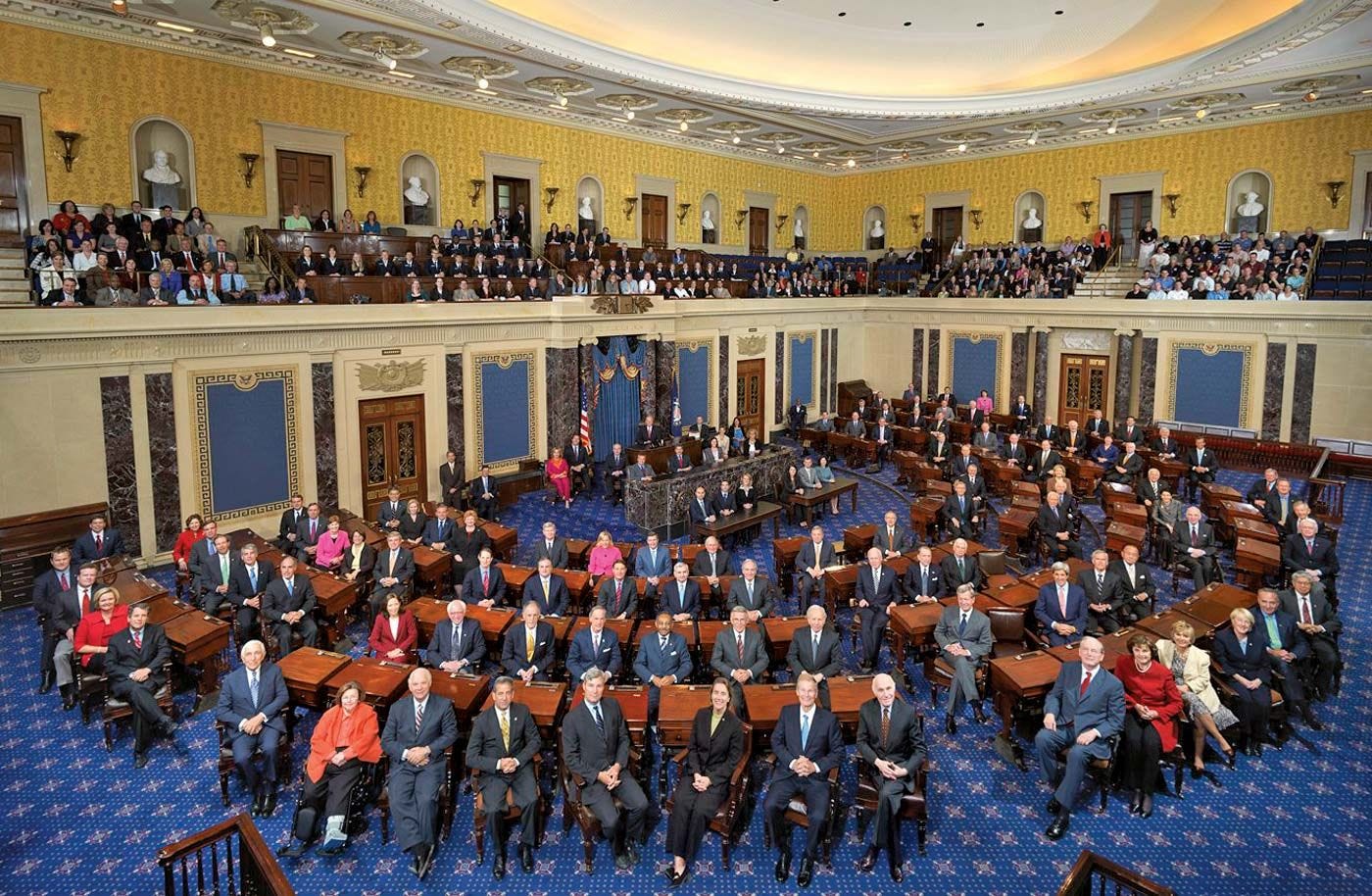
Similar to the block of essays about the House, No. 62-66 address the following questions for the Senate.
Who can be a Senator?
Madison first discusses the more stringent qualifications to become a Senator - thirty years of age and nine years as a citizen. The Senate is supposed to be older, wiser, and more important on a per-person basis than the House, and these qualifications are meant to reflect this.
How are Senators appointed?
We must remember that Senators were not elected by the people until the 17th Amendment in 1912. Prior to that, they were selected by the state legislatures. Why?
While the House was the legislative body representing the people, the Senate represented the states. For this reason, it made sense for their appointment to be made by the entity they represented. This formed an important link between the state and federal governments.
It’s worth taking a slight detour to understand why the 17th Amendment passed. By the end of the 19th century there were two primary problems with states appointing senators. First, there was steady evidence of corruption. Senators were being appointed not because they were the best person for the job, but because they were doing favors for members of the state legislature.
Second, and somewhat paradoxical to the first, was that state legislative elections were overwhelmingly being decided by who they would appoint to the Senate, rather than state specific issues. In many ways this mirrors the situation today, where people base their decision on state elections on the candidates expected relationship with the federal government.
These problems were debated for over 50 years before the 17th Amendment was passed in 1912 which made Senators appointed directly by the people.
How are senators proportioned by state?
Should Rhode Island get the same number of senators as New York? Madison thinks that no, they shouldn’t. But as with many parts of the Constitution, the outcome of equal representation is a result of compromise, this time between the large and small states.
But it is superfluous to try, by the standard of theory, a part of the Constitution which is allowed on all hands to be the result, not of theory, but “of a spirit of amity, and that mutual deference and concession which the peculiarity of our political situation rendered indispensable.”
Madison’s defense of equal representation in the Senate isn’t through a theory for why this is preferable, but through a lens of practicality. The goal was to form a government that unified all of the states, which is a preferable outcome even if there are sub-optimal elements that reflect this fact.
What’s the term length and purpose of the Senate?
While Madison was against equal representation in the Senate, he certainly wasn’t against the existence of a Senate. The smaller number, longer terms, and selection by the states, is supposed to act as a more refined and measured body that should check the “passions” of the house.
His argument for 6 year term lengths is just movement along the spectrum he defined in the House essay. Longer terms allow expertise to be gained, relationships to be cultivated, all in the service of sane governance. But he spends the most time on the idea that the Senate will check the passions of the people, represented by the House. What better way to explain this than the canonical example of “passions of the people” - the death of Socrates. Madison thinks the Athenians don’t execute Socrates if they have a senate:
What bitter anguish would not the people of Athens have often escaped, if their government had contained so provident a safeguard against the tyranny of their own passions? Popular liberty might then have escaped the indelible reproach of decreeing to the same citizens, the hemlock on one day, and statues on the next.
Madison closes out this section by addressing a concern of the Anti-Federalists that the longer term lengths and indirect appointment of Senators will lead to a tyrannical aristocracy. His response is that the six year term lengths and the separation of powers will prevent this. The British Parliament acts as a prudent example. The House of Lords, which is similar in spirit to the Senate, has lifetime terms determined by heredity. This should be the pinnacle of “tyrannical aristocracy”, yet their power has only waned relative to the House of Commons.
The powers vested in the Senate
No. 64-66 are written by Jay and Hamilton, and focus on two powers of the Senate outlined in the Constitution: ratification of treaties and appointments, and power over impeachment trials.
The Executive (No. 67-77, Hamilton)
Hamilton begins his explanation of the executive by going through the electoral college. The basic structure is the same that we have today: the people vote for state delegates, amounting to the states number of senators and representatives, who vote for the preferred presidential candidate. However, Hamilton’s vision is that these delegates are fully autonomous on who they can vote for, rather than as the pure pass-through entities that they are today.
The delegates in Hamilton’s day would be voted for once every four years, cast their vote for president, and dissolve. What’s the point? Why not have the people vote directly?
It was equally desirable, that the immediate election should be made by men most capable of analyzing the qualities adapted to the station, and acting under circumstances favorable to deliberation, and to a judicious combination of all the reasons and inducements which were proper to govern their choice. A small number of persons, selected by their fellow-citizens from the general mass, will be most likely to possess the information and discernment requisite to such complicated investigations.
There is no question that the authors of The Federalist Papers have a weariness of the masses, who tend to get stirred up by irrational “passions”. But it wouldn’t be totally right to label this provision as Hamilton being skeptical of pure democracy. Let’s try to put ourselves into the shoes of an average American in the 18th century. Aside from being under-educated, most people had very little information flow. There weren’t national campaigns with TV ads, yard signs, or televised debates. Most people didn’t even get newspapers - they went to a public forum where a newspaper was read aloud. This isn’t a great environment for the people to even know who’s running, let alone weigh the pros and cons of who they should vote for president.
Although, this system of independent delegates didn’t even last 20 years. But it wasn’t newspapers or the railroad that was its death knell, rather something the authors of The Federalist Papers completely missed: political parties. Political parties could act as the information curation vehicle for the average citizen. Instead of needing to know detailed information about all candidates, they could just determine their preferred party once, and vote for the proposed candidate every time.
Hamilton then moves to the philosophy of the president, where he lays out the structure for the rest of the executive essays. He begins by defending the idea that the executive must be able to do things. They must be able to take initiative, use judgement, be decisive and effective. He encapsulates all of these adjectives with the word “energetic.” The executive must be energetic in order to achieve effective government. His greatest concern was that the Anti-Federalists would metaphorically castrate the executive to uselessness.
He identifies four ingredients that are needed for an energetic executive: unity, duration, support provisions, and competent powers.
Unity
Unity addresses whether we have one executive or many. Remember that the founders were steeped in lessons of the ancients. Two of the most well known ancient governments, Sparta and the Roman Republic, had two executives.
Despite this, Hamilton argues that there should only be one. He gives a few reasons, but I found the best to be accountability. If one person is in charge, there is only one person to assign praise or blame. With two executives, it can be much harder to parse out where bad decisions come from.
Duration
Back to term durations. As with the legislative term limits, Hamilton is weighing effectiveness against liberty. The Anti-Federalists wanted shorter terms, but he felt four was proper.
As, on the one hand, a duration of four years will contribute to the firmness of the Executive in a sufficient degree to render it a very valuable ingredient in the composition; so, on the other, it is not enough to justify any alarm for the public liberty.
While the authors do a good job of laying out the structure of the spectrum, the determinations are quite un-scientific. Maybe the difference between 4 and 6 year presidential terms would push us to tyranny. Or maybe it wouldn’t, instead increasing presidential effectiveness by 50%. I have no idea.
Hamilton also argues in favor of re-eligibility, that is, unlimited term limits (Madison also agreed). However, Washington and Jefferson’s precedent of two terms followed by the 22nd Amendment means we’ve never really played around with anything more than two terms. We had some arbitrary tradition, then FDR spooked the republicans enough to codify that tradition. Was FDR a pseudo tyrant? Or was he an effective president carrying out the mandate of the people during an extraordinary time? Depends who you ask. Either way, I find it interesting that we never really had a proper debate on something where we ended up so far from the founders intentions.
Support Provisions
The third factor to ensure an energetic executive is to ensure the president isn’t reliant on the legislature for his well-being. While the legislature determines the executive salary, they Constitutionally can’t change it inter-term. I figure Hamilton would be happy to know that modern day presidents ability to monetize their position has significantly reduced the relevance of their salary.
Competent Powers
The last ingredient for an effective executive is having the power to do things. He essentially goes through the executive powers outlined in the Constitution: power of the veto, command of the military, power of the pardon, treaty power, and appointments. But it’s worth noting the relative sparsity of this section compared to defining powers of the legislature.
The Judiciary (No. 78-83, Hamilton)
Hamilton spends the next six essays defending Article III of the Constitution, which is about the Judicial branch. The Judiciary, Hamilton begins, is the least dangerous branch because it has no ability to create laws or enforce its judgements.
The judiciary, on the contrary, has no influence over either the sword or the purse; no direction either of the strength or of the wealth of the society; and can take no active resolution whatever. It may truly be said to have neither force nor will, but merely judgment; and must ultimately depend upon the aid of the executive arm even for the efficacy of its judgments.
However, if either of the other branches were to get ahold of the judiciary, it would spell the end of liberty. The only way to protect the court from the other two branches is through lifetime term lengths. Being appointed for life should reduce the pressure on the court to do anything except their primary duty: to interpret constitutionality. Hamilton also addresses whether it should be possible to remove judges for “inability”, to which he says no. This would be too subjective, and could too easily be manipulated for political gain. (Note that inability does not include misconduct).
The rest of the judiciary essays focus on jurisdictional questions and logistics. The Anti-Federalists were concerned that the federal judiciary would encroach on the sovereignty of the states to make their own decisions on their own laws. Hamilton explains how this won’t be an issue, since the judiciary only has authority over:
Federal Laws
State laws that touch the Constitution (such as coining money)
Where the federal government is a party to a suit
Anything involving foreign nations, ambassadors, or maritime cases
Anything involving more than one state
This might seem like a lot, but it’s really not. The majority of everyday cases would not fall into these buckets, and be handled by the state courts. The big change came with the 14th Amendment, which expanded the Constitutional power over the states, which naturally expanded the jurisdiction of the court.
I have to admit this block of essays was the most challenging for me to understand. However, my analysis is that the Judicial Branch is perhaps working as close as possible to how the founders intended, more so than any other branch, by far. Political leanings are not the same as political capture, and judges seem to not be beholden to the politicians that put them on the court. Despite whether I agree, the opinions issued by the court are well researched, academic, and philosophically aligned with the purpose of the court. That’s more that can be said of Congress or the president.
Why we don’t need a Bill of Rights (No. 84, Hamilton)
The penultimate essay of The Federalist Papers is one of the few where Hamilton is arguing for something that Madison later disagreed with: that we don’t need a bill of rights.
However, this position is not as radical as it seems. Hamilton is not disagreeing with the rights themselves, just that a bill of rights is an incorrect method of preserving them. Bills of rights have existed since the Magna Carta as a way for the people to carve out specific protections against the monarchy. When the King had all the undeclared powers, a bill of rights was necessary - if it wasn’t in the bill of rights, the people didn’t have that right.
But the proposed Constitution was not a monarchy, it was a government by the people. Any power not explicitly called out in the Constitution remains with the people. Hamilton believed that the people don’t need to “reserve” rights they never gave away.
He then takes it a step further, not only is a bill of rights unnecessary, it can be actively harmful. Having a bill of rights assumes that any rights not listed are unprotected.
In the end, Hamilton was overruled, and a Bill of Rights was ratified a few years later in the form of the first ten amendments. However, the Ninth Amendment owes its existence to the argument that Hamilton makes in this essay. It reads:
The enumeration in the Constitution, of certain rights, shall not be construed to deny or disparage others retained by the people.
I think Hamilton missed the mark on his reasoning, as evidenced by how little the 9th Amendment comes up in practice. Mostly because how does one go about defining the “other rights” retained by the people?
Concluding Remarks (No. 85, Hamilton)
Hamilton ends The Federalist Papers in a humbler fashion. He admits that while the Constitution isn’t perfect, it’s the best thing we’ve got, and it would behoove us to accept it. And the amendment process will allow it to continue improving into the future. He reiterates the point Madison made in No. 37 that a compromise of 13 bodies can never perfect for everyone.
The compacts which are to embrace thirteen distinct states in a common bond of amity and union, must as necessarily be a compromise of as many dissimilar interests and inclinations. How can perfection spring from such materials?
So what?
It’s not a secret that, despite being one of the oldest, the US system of government is less common than the parliamentary system. Additionally, if you analyze the results of the countries that adopt either system, parliamentary systems appear to sustain democratic government better than presidentialism. After reading the Federalist Papers, I think I understand why.
The Constitution was not the result of optimal governmental theory, it’s the result of compromise. This is admitted outright by Madison throughout his essays, especially No. 37 and No. 62. If you’re a country that wants to adopt a Constitution-like system, you don’t need your government to be the result of accommodating Rhode Island and Delaware.
While the US system of government may not work for most countries that try to adopt it, it seems to have worked relatively well for the country that it was designed for. But admittedly, it’s impossible to parse out the causality of the Constitution’s contribution to the success of America. Geography and culture are significant contributors towards America’s power that would likely have made many other democratic systems work. We cannot run a double blind experiment on what America would look like with a system other than the one we have.
We can also reinvoke the lesson Madison taught us in No. 10. America has become a successful large democracy precisely because we are a large democracy. Small countries with homogenous economic interests create a tyranny of the majority that causes instability for the long term prospects of the democratic government. Petrol states’ inability to maintain functional democracies is explained through this lesson.
Another takeaway is that the basis for the US Constitution comes largely from three sources: Lockean liberalism, 2,000 years of European historical precedent, and Montesquieu’s The Spirit of the Laws. I am not smart enough to intuit how another 250 years of history and countless volumes of political theory would have caused the founders to modify their approach. But there are various themes that I wonder if the founders would maintain if they came back today.
First, the distrust of the populace. “Distrust” is probably too strong a word, but concern over mob rule and the “passions” of the people drips across the pages. This isn’t all that surprising when we remember that all the founders were steeped in classical education. Plato was skeptical of democracy because of what it did to Socrates, and Socrates is mentioned more than a few times throughout the The Federalist Papers. Perhaps the most poignant example is that senators and the president were not originally elected by the people.
Second, is the size of the Federal government. The initial reasons for a federal government was foreign policy, inter-state regulation, and defense. Our Federal government has become much more than that. But in the end, if the directionality of the federal government’s size is due to the will of the people, then we may not have strayed far from the founder’s vision at all. Also, Hamilton spends a lot of time on means. Technology has expanded the means of everyone, the government included, over the last 240 years. Just because the means for a larger government didn’t exist in 1788, doesn’t convince me they’d be against it a priori.
My final quintessence, and what I think is the most lasting philosophical impact of The Federalist Papers, is that good government must depend on structure rather than virtue. You can never eliminate ambition or faction, but you must design a system to harness it towards the general welfare of the people. And whether they did a good job of that will never truly be settled.